 FlagAlert
Plain-English answers to the questions people actually ask about flying the American flag. They follow the U.S. Flag Code, which is exact about some of this and simply silent on the rest.
⌕
The Flag CodeDisplay RulesHalf-Staff ProtocolFlagpole & HardwareFlag Care & ConditionFlag RetirementHouse-Mounted Flags
The Flag Code
Flag etiquette in the United States is governed by the U.S. Flag Code, codified in Title 4, Chapter 1 of the United States Code (4 U.S.C. §§ 1–10). It defines the accepted customs for displaying and honoring the American flag — including the half-staff rules in Section 7, "Position and manner of display." The code was first drafted at the National Flag Conference in 1923 and enacted into federal law by Congress in 1942. Under the code, the President of the United States may alter or modify its rules by proclamation or executive order.
For private citizens, no. The Flag Code is a guide to proper etiquette, not an enforced statute — it carries no penalties, and there is no "flag police." Displaying the flag correctly is a matter of respect and long-standing custom rather than legal obligation. Federal agencies and the military follow the code as a matter of policy. Half-staff orders are the practical exception: when the President (nationwide) or a state governor (within their state) issues one, it sets the official protocol that government facilities follow and that most flag-flyers choose to honor.
Display Rules
The flag should be displayed from sunrise to sunset on buildings and flagpoles. It may be displayed 24 hours a day if properly illuminated during darkness. The flag should not be displayed in inclement weather unless an all-weather flag is used.
Yes — as long as the flag is properly illuminated. A solar-powered or electric light shining on the flag satisfies this requirement. Many businesses use solar spotlights at the base of the flagpole for this purpose.
No. An indoor flag on a fixed staff has no halyard and no meaningful midpoint, so it cannot be lowered. A black mourning ribbon at the top of the hoist is the accepted alternative, exactly as on a fixed outdoor mount.
Standard flags should be taken down in inclement weather. However, all-weather flags made from nylon or other synthetic materials may be flown in any weather. If your flag is cotton or wool bunting, bring it in during rain, snow, or high winds.
Half-Staff Protocol
At the federal level, only the President of the United States can order flags to half-staff nationwide. State governors can order flags to half-staff within their state. No other official has this authority, though many people incorrectly assume mayors or local officials can issue such orders.
Half-staff means the flag is flown one-half the distance between the top and bottom of the staff. The proper procedure is to first raise the flag to the peak and then lower it to half-staff. When taking it down, raise it back to the peak before lowering it completely — this is called 'two-blocking.'
By Presidential Proclamation, flags fly at half-staff from sunrise until noon on Memorial Day, honoring those who died in military service. At noon, flags are raised to full-staff to honor living veterans. This two-step protocol is one of the most commonly missed flag rules — which is exactly why FlagAlert sends a mid-day reminder.
No. The Flag Code has no civil penalty. Half-staff orders are binding on federal and state facilities, not on private homes.
Duration depends on who died. For the President or former President: 30 days. Vice President, Chief Justice, Speaker of the House: 10 days. Associate Justice, Secretary of a Department, former VP, or Governor: from death until interment. Member of Congress: day of death and the following day.
Flagpole & Hardware
Any light that clearly illuminates the flag at night satisfies the legal requirement. The most popular option for businesses is a solar-powered ground spotlight aimed at the flag — they turn on automatically at dusk and require no wiring. On a tall in-ground pole a collar light is awkward to retrofit around the halyard, so a ground uplight is usually the better answer there.
The flag's fly (length) should be roughly one-quarter to one-third the height of the pole. For a 20-foot pole, a 4×6 or 5×8 flag is appropriate. For a 30-foot pole, a 6×10 flag is standard.
Flag Care & Condition
A flag should be replaced when it becomes torn, frayed, faded, or soiled to the point that it no longer presents a respectable appearance. Flying a worn or tattered flag is considered disrespectful. As a general rule, outdoor flags typically last 3–6 months with daily flying.
Most nylon and polyester flags can be hand-washed in cold water with mild detergent and air-dried. Cotton flags should be dry-cleaned. Never put a flag in a dryer on high heat. Always handle the flag with care and do not let it touch the ground during cleaning.
Flag Retirement
The U.S. Flag Code states that a flag that is no longer a fitting emblem for display should be destroyed in a dignified way, preferably by burning. Many VFW posts, American Legion chapters, and Boy Scout troops hold regular flag retirement ceremonies and will accept worn flags.
Most local VFW posts and American Legion chapters accept worn flags for retirement ceremonies. Many Post Offices and fire stations also participate. Communities typically hold retirement ceremonies around Flag Day (June 14) and Veterans Day (November 11).
House-Mounted Flags
No. There’s no halyard and no meaningful midpoint on a short angled staff. Attach a black mourning ribbon instead and leave the flag where it is.
At the top of the hoist, at or just below the finial. On most porch brackets the flag is fixed right under the finial, so the ribbon clips to the same top grommet and hangs in front. If your staff leaves bare pole above the flag, tie it there instead — it spares the grommet, which is the part of a house flag that fails first.
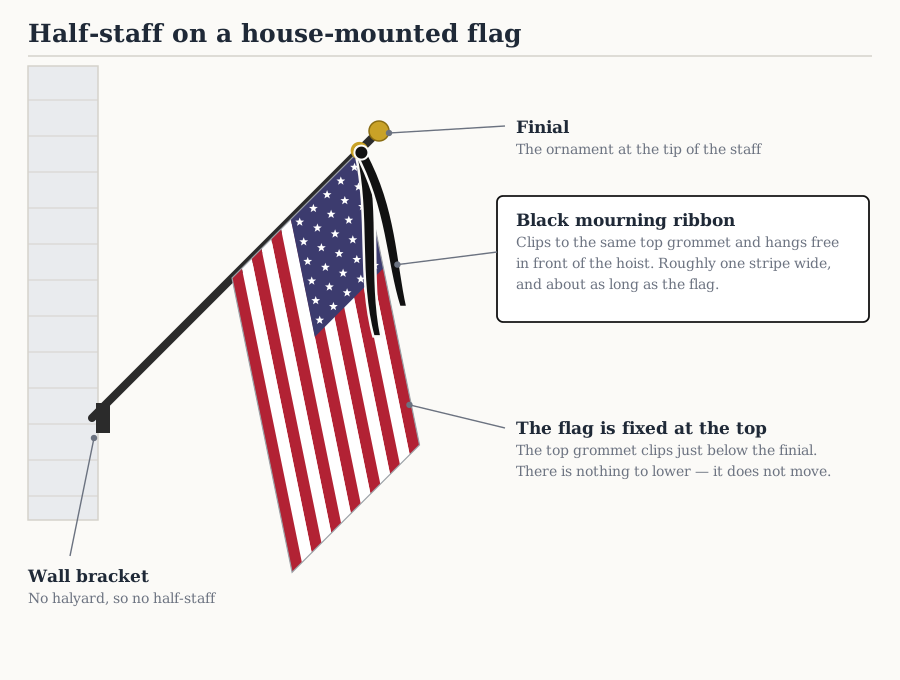
For a 3′×5′ flag, roughly 2–3 inches wide and about 5 feet long. Guidance ranges from “one stripe wide and the length of the flag” to “10% of the flag’s width and twice its length.”
Attach it at sunrise and remove it at noon, matching the half-staff-until-noon rule. The flag stays at the top of the staff all day.
No. A plain black flag isn’t a recognized mourning display in the U.S. and carries other associations.
Never miss a half-staff order
Knowing the rules is half of it — the hard part is knowing the exact day. FlagAlert sends you an SMS and email the moment a federal or state half-staff order is issued.
Get started →Cancel anytime